Strange Fire
Parashat Shmini, Artemis II, and fire from heaven

Throughout history, students of the Torah have observed that the weekly portion, read on the same schedule by Jewish communities, Messianic congregations, and seekers across many traditions worldwide for centuries, has a way of directly connecting to current events. Sometimes the connection is loose, a matter of interpretation, and sometimes it is specific enough to make you stop and think.
This week’s portion is Parashat Shmini, meaning “the eighth.” It opens on the eighth day, the day of inauguration of the Tabernacle. Aaron was the brother of Moses and the first high priest of Israel. Aaron and his sons entered consecrated space for the first time to offer sacrifices before God. Holy fire came from the presence of the Lord and consumed the offering on the altar. The people shouted and fell on their faces. Then Aaron’s sons Nadab and Abihu offered strange fire, unauthorized fire. They were consumed by the same force that had just blessed everything moments before. The difference was not in the appearance of the flames. It was in the origin.
What Shmini arguably establishes is not just an event, but a pattern. Moments where heaven answers by fire, and the meaning of that fire depends entirely on its source.
On April 10, 2026, four astronauts returned from the farthest point any humans have ever traveled away from the Earth. The Artemis II crew chose the name Integrity for their Orion capsule. The word traces back to the Latin for wholeness, for what remains unbroken. The crew chose the name, according to NASA, to symbolize the foundation of trust, respect, candor, and humility behind the mission, and to reflect the integration of more than 300,000 individual components that had to come together for the spacecraft to fly.
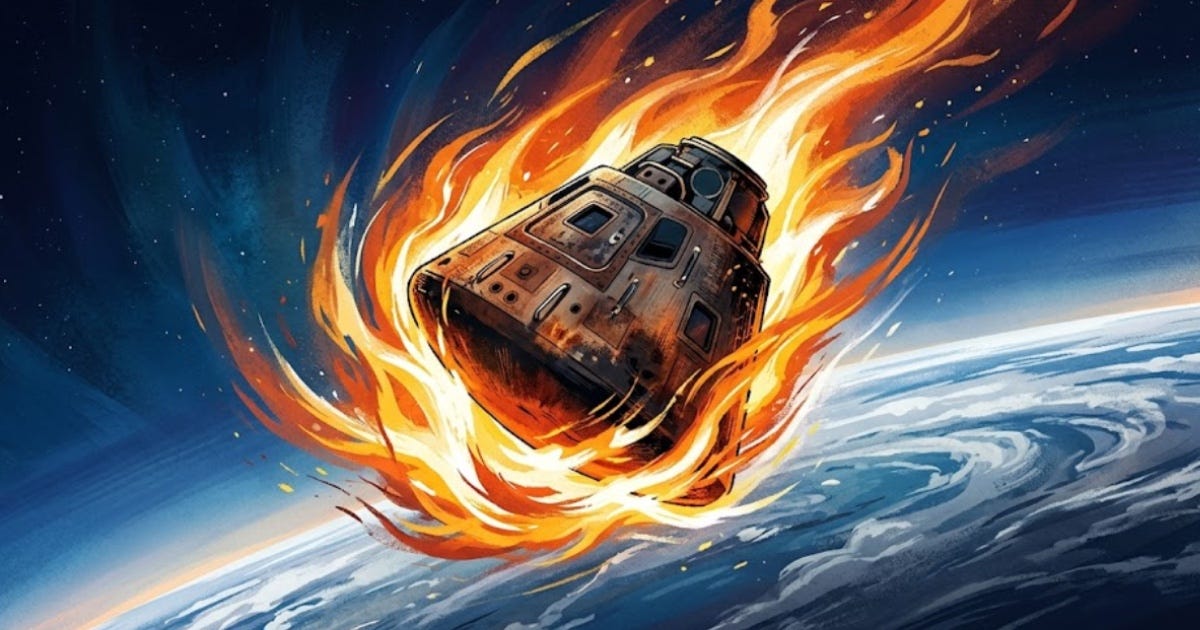
During its re-entry Integrity passed through superheated plasma fire. All then went silent for six long minutes. The commander’s first transmission coming out of blackout was, “Houston, Integrity. We have you loud and clear.” Then eight minutes after entry, Orion crossed the 100,000 feet line. That is roughly 19 miles above Earth’s surface. It is a point of altitude where the atmosphere becomes dense enough for parachutes to function. Additionally, it is where aerodynamic control becomes possible again after reentry.
Astronaut Victor Glover served as a pilot during the historic mission. Glover previously piloted the SpaceX Crew-1 mission in 2020–2021 and spent 168 days aboard the International Space Station. Glover is a vocal, devout Christian and a member of the Churches of Christ, he brought communion cups aboard Integrity, a practice he had established during his mission to the International Space Station. Additionally, he brought a Bible aboard and read it during the mission. Before the crew passed behind the moon and entered a 40 minute time of radio silence Glover stated over the broadcast channel “As we continue to unlock the mysteries of the cosmos, I would like to remind you of one of the most important mysteries there on Earth — and that’s love. Christ said, in response to what was the greatest command, that it was to love God with all that you are. And he also, being a great teacher, said this: ‘I give you equal to it, and that is to love your neighbor as yourself. And so, as we prepare to go out of radio communication, we’re still able to feel your love from Earth and to all of you down there on Earth, and around the Earth, we love you from the moon.”
Later April 4th when a reporter asked him if he had any Easter thoughts to share, he said he had nothing prepared. Then said this: “You’re on a spaceship called Earth that was created to give us a place to live in the universe. In all of this emptiness, this is a whole bunch of nothing, this thing we call the universe, you have this oasis, this beautiful place that we get to exist together.”
Returning to the Bible, towards the end, Revelation 13 describes two beasts. The second, later called the False Prophet, acts in service of the first. Verses 12 and 13 read: “It exercises all the authority of the first beast in its presence, and makes the earth and its inhabitants worship the first beast, whose mortal wound was healed. It performs great signs, even making fire come down from heaven to earth in front of people.”
This is not a general image of power, but a direct echo of a known event in Israel’s history.
The Revelation reference points to a specific moment in 1 Kings 18. The prophet Elijah stood on Mount Carmel and challenged 450 prophets of Baal to a contest. Both sides would prepare a sacrifice. Whichever God answered by fire would be acknowledged as the true God. The prophets of Baal called out all day. Nothing answered. Elijah prepared his sacrifice, soaked it with water three times, and prayed. Fire fell from the Lord and consumed the offering, the wood, the stones, and the water in the trench around it. The people fell on their faces.
In all three cases, the sign is identical. Fire from beyond. The meaning is determined by who created it.
Revelation 13 describes the False Prophet performing a sign so specific it can only be read as a direct imitation of that moment. Real fire. Called from the sky. In front of witnesses. The difference, then and in John’s vision, is the same difference Shmini identifies. Not the fire itself. The origin.
If the meaning of the fire depends on origin, then the question extends beyond the event itself to the systems that frame and name these moments. That includes the institutions responsible for carrying human beings into and through that fire.
NASA’s naming conventions have always drawn from pagan mythology. Artemis, Apollo, Mercury, Orion. Jack Parsons, one of the founding figures of the Jet Propulsion Laboratory, was a practicing Thelemite and associate of Aleister Crowley. That is documented history, not speculation. Whether NASA’s current naming conventions reflect continuity of that esoteric founding or simply a longstanding tradition of classical reference is a question worth asking. The individuals who flew this mission are not implicated in that history. People do not always know what they are part of and additionally, institutions, over time, like people can change. They may adapt, fragment, and/or reform. What begins as one thing does not always remain that thing. They may even become strengthened through the fire.
On April 10, 2026, a vessel named Integrity passed through plasma fire and seemingly came out whole.
You could also show support by buying me a coffee.